
Civic Insights with David Billings
It is Labor Day weekend. College football is well underway, and the NFL season starts next week. We have all seen the drama surrounding college football in recent months. Budget season creates its own kind of drama.
Our next article focuses on something slightly less exciting: the City of Rockwall budget.
After reviewing the proposed budget, four issues stand out:
- General Fund expenditures are growing faster than revenues, which could gradually reduce the City’s operating margin if the trend continues.
- Public-safety workload is growing faster than population, while staffing has remained relatively flat in several key areas.
- Road maintenance, road debt, and the pace of project execution deserve closer attention, particularly as Rockwall continues to grow.
- The City remains financially healthy, but long-term planning will become increasingly important as recurring costs, infrastructure needs, and potential state-imposed spending limits reduce future budget flexibility.
1. City Tax Rate Remains Stable
Rockwall’s proposed FY2027 property-tax rate is $0.258007 per $100 of assessed value. That is essentially flat compared with the current rate of $0.257500 and is equal to the City’s calculated no-new-revenue rate.
The proposed rate is divided into two parts:
- Maintenance and Operations: $0.168857
- Debt Service: $0.089150
- Total: $0.258007
About 65% of the tax rate supports City operations, while roughly 35% is dedicated to debt service.
For the average taxable homestead value of $484,079, the City estimates the annual property-tax bill at approximately $1,249, an increase of about $30 from the prior year, or roughly $3 per month. Yes, a cheesy analogy could be created, but we will resist the temptation.
The more important point is that Rockwall is not relying on a significant property-tax-rate increase to balance the FY2027 budget.
Instead, the City is benefiting from new taxable commercial growth. Total assessed value increased approximately 2.42%, while the value of existing property actually declined about 0.55%, meaning essentially all of the net tax-base growth came from new development.
Rockwall also benefits from the work of the Rockwall Economic Development Corporation. The Rockwall Technology Park helps broaden the tax base and supports jobs and economic activity across the community.
That is a positive sign for taxpayers, but it also reinforces the importance of watching whether future service and infrastructure costs grow faster than the new revenue generated by that development.
2. Investments in Police and Fire
Public safety remains Rockwall’s largest General Fund commitment. The FY2027 proposed budget allocates approximately $30.3 million to Police, Fire Operations, and the Fire Marshal—about 54.7% of General Fund operating expenditures.
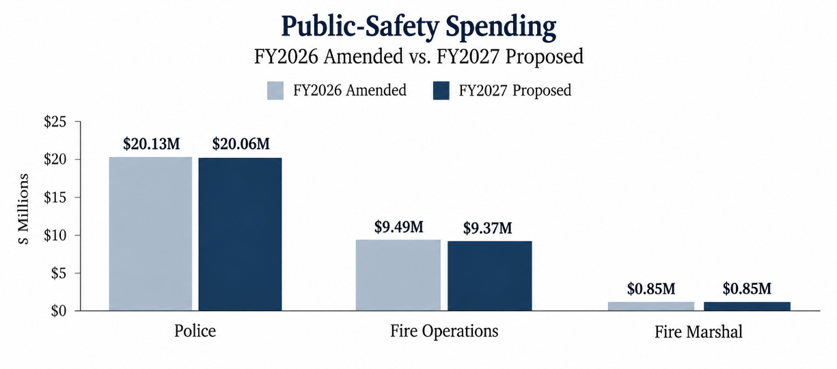
Despite that large commitment, spending is not increasing significantly from the current amended budget. Police spending declines slightly from approximately $20.13 million to $20.06 million, Fire Operations declines from $9.49 million to $9.37 million, and Fire Marshal spending remains unchanged at approximately $848,000.
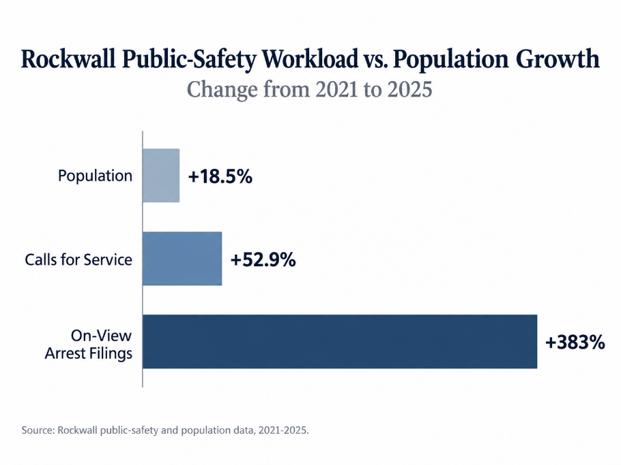
The more important issue is whether relatively flat spending can keep pace with a growing workload. Between 2021 and 2025, Rockwall’s population increased 18.5%, calls for service increased 52.9%, and on-view arrest filings increased 383%. During those four budget cycles, no new patrol officer positions were added.
Rockwall continues to invest in vehicles, communications, equipment, and technology, which may allow existing personnel to work more efficiently. But that leads to an important question:
How does Rockwall determine the right balance between staffing, technology, vehicles, and equipment to maintain public-safety service levels as the City grows?
3. Road Maintenance Matters
Rockwall’s Streets budget increases materially in FY2027. The FY2026 amended Streets budget is $4.56 million, compared with $5.32 million proposed for FY2027—an increase of about $756,000, or 16.6%.
Within that total, the supplies category, which includes much of the City’s street and pavement maintenance spending, increases from about $2.47 million to $3.22 million—an increase of approximately $745,000, or 30.2%.
That is a significant increase, but the budget packet still does not tell residents how many road or lane miles Rockwall is responsible for maintaining or what level of annual investment is needed to keep the street network in good condition.
Without those benchmarks, it is difficult to determine whether the increased funding is enough to keep pace with maintenance needs or whether deferred work will eventually become more expensive reconstruction.
The key question is: How many road or lane miles does Rockwall maintain, what is the estimated annual cost to keep them in good condition, and is the FY2027 maintenance budget sufficient to meet that need?
4. Rockwall Is Financially Healthy — For Now
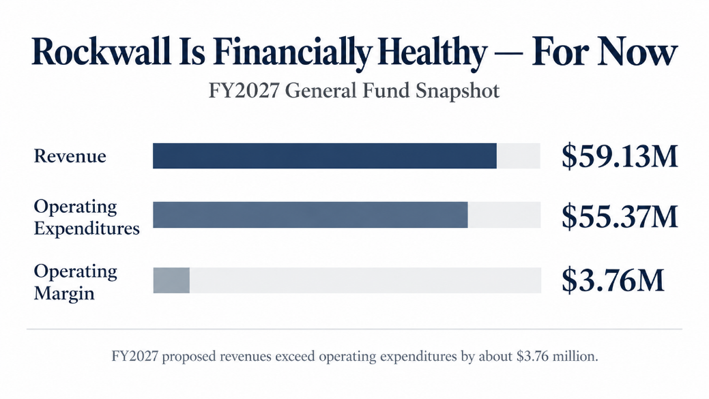
Rockwall’s proposed FY2027 budget presents a city in relatively strong financial condition. Revenues exceed operating expenses, reserves remain healthy, and the proposed property-tax rate is essentially at the no-new-revenue rate.
Those are all good things for Rockwall.
The concern is not Rockwall’s financial position today. The concern is whether future revenue growth will continue to keep pace with staffing, infrastructure, debt, and other recurring costs as the City shifts toward a slower-growth model.
Final Thoughts (JFND)
Think of Rockwall’s budget like a Rockwall football program moving from a wide-open, high-scoring offense to a slower, ball-control game.
The Rockwall budget and the broader public debate have raised several important questions that deserve a civil conversation among all of us.
One issue is the relentless focus on using the No-New-Revenue rate as the target. As taxable values on existing property grow more slowly or decline, the calculated No-New-Revenue rate can move higher. The tax rate alone, therefore, does not always tell the full story about the City’s financial position or future service needs.
There is also a potentially important state-policy question. If the Texas Legislature adopts a local-government expenditure cap tied to population growth plus inflation, how would Rockwall protect public-safety staffing if calls for service and investigative workload continue to grow faster than population?
The harder question is whether Rockwall’s long-term spending, staffing, road maintenance, and debt plans are adjusting to a city moving from rapid growth to a slower-growth model.
That transition matters. Slower population and appraisal growth can reduce the pace of new revenue, while the cost of maintaining roads, public-safety service levels, facilities, and existing infrastructure continues.
So the discussion should not focus simply on whether the tax rate went up or down. It should focus on whether Rockwall’s financial plan is adapting to slower growth while still maintaining the services and infrastructure residents expect.
Sources
- City of Rockwall, FY2027 Proposed Budget / City Council Budget Packet (August 27, 2026). Key pages used in this article: p. 25 (tax rate, assessed value, General Fund revenue); p. 48 (No-New-Revenue rate and tax-rate components); p. 64 (General Fund expenditure summary); p. 82 (Fire Operations); p. 85 (Fire Marshal); pp. 95–100 (police workload, staffing requests, vehicles, communications, and technology); p. 131 (Streets budget).
- City of Rockwall Finance Department, FY2027 Proposed Budget. The City’s Finance Department webpage provides the proposed FY2027 budget and prior-year adopted budgets.
- Rockwall Economic Development Corporation, Rockwall Technology Park / Phase III materials. REDC describes the Technology Park as an economic-development tool intended to broaden the community tax base and support employment and business investment.
- Texas Legislature Online, H.B. 73, 89th Legislature, Second Called Session (2025), introduced version. The proposal would have limited annual municipal and county expenditures using a rate tied to statewide population growth plus inflation, subject to specified exceptions. The bill is cited here as a policy proposal, not as current law.
Online references: City of Rockwall Finance | Rockwall EDC | Texas Legislature H.B. 73
🎙️ Continue the Conversation
Listen to my podcast, “As Fate Would Have It.” My co-host Dave Martin, host of The Good Government Show, joins me as we talk with government and local leaders about what’s happening in Fate and across Rockwall County.
New episodes drop monthly. Give it a listen and let me know what topics you’d like us to cover.
About the Author

David Billings, former Mayor of Fate, has served the community for over a decade. A longtime business leader in the telecommunication industry, Navy veteran, and resident of Rockwall County, he brings both professional and civic experience to his writing on government, budgeting, and local economics. He is a graduate of Leadership Rockwall, North Texas Commission Leadership Program, active in several Rockwall County non-profits boards, and the American Legion.
He is passionate about civic involvement in local government, maintaining transparent governance and thoughtful strategic planning to preserve a bright future for the regions.